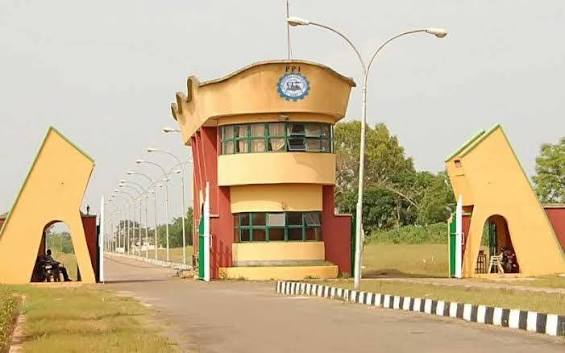
The Federal University of Technology, Ilaro (FUTI) is set to deepen its identity as a technology-driven institution, with the school targeting the 2027/28 academic session to commence full university operations.

This is according to the Acting Vice-Chancellor, Dr. Mukail Aremu Akinde, who spoke as he marked four years at the helm of the institution.
Akinde said the emerging institution must develop an identity firmly rooted in practical engineering and industrial problem-solving.
He said the next phase of his administration would focus on strengthening the “Engineering Identity” of FUTI, particularly through hands-on technical training, research and the practical application of knowledge.
“We want to strengthen the Engineering Identity of FUTI,” he said, stressing the importance of “hands-on technical skills, research and practical application of knowledge.”

According to him, the goal is to move beyond research that remains within academic spaces and create an environment where innovations can be replicated, commercialised and deployed to solve real-world problems.
“The objective is to create an environment where research can be replicated and applied to real-world industrial and societal needs,” he said.
This engineering push builds on a major expansion of the institution’s academic structure over the past four years.
Since Akinde assumed office on September 27, 2022, as Rector of the then Federal Polytechnic, Ilaro, the institution has grown from fewer than 10,000 students to more than 27,000.
Its academic departments and programmes have also expanded from 34 to more than 100, while the number of schools has grown from six to eight, with the addition of the School of Agriculture and the School of Art and Design and Printing Technology.
New programmes introduced include:
- Metallurgical Technology
- Automotive Technology
- Auto-body Technology
- Mechanical Engineering Technology
- Mechatronics
- Cement Technology
- Welding and Fabrication
- Renewable Energy
- Agricultural Technology
- Animal Health
- Horticulture
- Crop Production
- Agricultural Extension
Akinde said many of these programmes were deliberately introduced to meet Nigeria’s industrial manpower needs.
He specifically cited the Welding and Fabrication and Cement Technology programmes, which he said were developed to provide specialised manpower for industries including Dangote Cement’s Ibese plant, other cement companies and the emerging industrial ecosystem around the Dangote refinery.
The institution’s practical orientation is also visible in projects already underway.
FUTI is currently fabricating 11 electric and solar-powered tricycles for campus transportation.
Its Schools of Engineering and Pure and Applied Sciences have also developed equipment for gari processing, waste conversion, agricultural applications, printing and other production processes.
Technologies developed and patented by the institution include a 3-in-1 electric tricycle incorporating solar and CNG technology, an IoT-enabled solar egg incubator and hatcher with dynamic environmental control, an integrated mixer and extruder for mechanised kokoro production, a motorised palm-oil digester, a compact plastic-bottle shredder, and a customised biometric system for staff and students’ attendance and access control.
Despite the progress, Akinde played down the achievements recorded so far.
“We haven’t done anything, other than that we have to do more collectively with the Council, Principal Officers, Deans, Directors, Heads of Department, Heads of Units, Staff, Students and the Unions,” he said.
He said the transition from the Federal Polytechnic, Ilaro, to the Federal University of Technology, Ilaro, offers an opportunity to build an institution whose academic identity is closely tied to Nigeria’s technological and industrial development.
According to him, the transition is being handled strategically, with committees led by former University of Lagos Vice-Chancellor, Professor Ramon Bello, and Dr. Charlotte Bose Iro-Idoro overseeing different aspects of the process.
“Our people should know that the work of changing FPI to FUTI is progressing. Only that thing must be done strategically,” Akinde said.
The institution is targeting the 2027/28 academic session for the commencement of university education, subject to the required processes, including preparations for National Universities Commission verification.
The Acting Deputy Vice-Chancellor, Academics, Dr. Charlotte Bose Iro-Idoro, said FUTI is preparing to commence university operations with nine faculties covering Engineering Technology, Sciences, Environmental Technology, Communication and Information, Administrative and Management Sciences, Social Sciences, Computing, Agricultural Technology and Visual Arts.
The Registrar, Mrs. Aderonke Folasade Babatola, said the institution now has at least 80 PhD holders, while 371 new members of staff have been recruited in two batches of 146 and 225.
She added that the institution was seeking waivers to enable it to recruit more professors.

Digital Operations Manager at The Students Forum Nigeria.