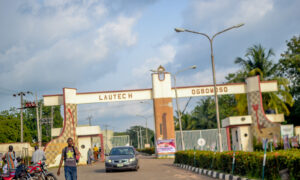
President Bola Tinubu has commissioned Africa’s first renewable energy college, the Barefoot Renewable Energy College, Osara (BARECKS), along with a Green Hydrogen Research and Demonstration Pilot Plant, both located at the Confluence University of Science and Technology, Osara, Kogi State.

Vice President Kashim Shettima performed the commissioning on behalf of the President on Tuesday, marking a significant milestone in Nigeria’s push to build the technical workforce needed for its clean energy transition.
The President described the college as a world-class institution completed to international standards, saying it was modelled after celebrated vocational colleges in India that trained ordinary women with no formal education to become solar engineers.
“This is the first institution of its kind on the African continent, modelled on the celebrated vocational colleges of India that turned unlettered grandmothers into solar engineers. If that method could light the villages of Rajasthan, it can light the settlements of Kogi, Ondo and Cross River. Nigeria assumes, from today, the position of pacesetter in renewable energy capacity development across Africa,” Tinubu said.
He acknowledged that despite Nigeria’s abundance of sunlight, wind, biomass, and water, the country had long struggled to convert those resources into electricity, jobs, and economic opportunities.

“Our continent has never suffered a deficit of intention. We have suffered the scarcity of hands trained to execute them,” he said.
The college is designed as a vocational and technical institution to address what the President called the widest gap in Africa’s energy transition, the shortage of competent technical manpower. It will train technicians, installers, operators, and maintenance professionals with practical skills in renewable energy technologies.
Tinubu also used the occasion to highlight the speed of the project’s delivery, a point he said carried particular significance in a country where infrastructure projects routinely outlast the administrations that initiated them.
“Two years ago, we stood on this ground for the groundbreaking of this institution, with red earth underfoot and the ambition of a few determined Nigerians for company. Today, we stand before a world-class edifice, completed to international standards,” he said.
The President called on development partners, private sector organisations, international institutions, and research bodies to collaborate with the college in expanding research, innovation, and technical training.
The commissioning comes as Nigeria works to implement its Energy Transition Plan, which outlines a roadmap to achieve net-zero emissions by 2060. Nigeria needs at least five million off-grid solar systems to serve unpowered and underserved communities, according to data from the Rural Electrification Agency.
Financial flows to developing countries including Nigeria for clean energy projects have also surged to $21.57 billion, while energy experts say Nigeria could unlock an estimated $2.5 billion carbon market opportunity through stronger investment in large-scale solar installations.

Digital Operations Manager at The Students Forum Nigeria.